
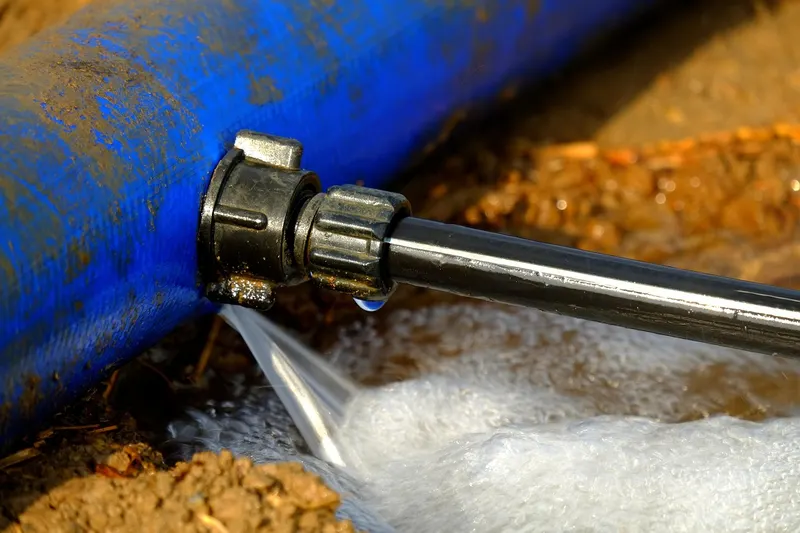
Is the low water pressure a new or ongoing problem?
The first step in diagnosing low water pressure is determining if it's a new or ongoing issue S1. If the problem has just started, it might be a temporary situation, such as a water main repair in your area, which should resolve itself once the water system returns to normal S1. Water main breaks or other disruptions to the water system can cause these temporary pressure changes S2.
However, if low water pressure is a long-term or frequent problem, the cause is likely closer to your home's plumbing system S1. In such cases, the issue could stem from various factors within your property, including a slightly closed main shut-off valve, a malfunctioning pressure-reducing valve (PRV), or even leaks and blockages in your pipes S3. For instance, galvanized plumbing can develop clogs that restrict water flow over time S1.
Addressing these internal plumbing issues often requires a more thorough investigation. You might need to check your main shut-off valve to ensure it's fully open or inspect your PRV, which regulates water pressure entering your home S3S4. Leaks, even small ones, can significantly reduce water pressure because water is escaping before it reaches your faucets S3. These leaks can also lead to substantial water waste, with an average household losing over 9,300 gallons annually S5.
Is the low water pressure affecting all faucets or just some?
The first step in diagnosing low water pressure is to determine if the issue affects all faucets or only specific ones S3. This distinction helps pinpoint whether the problem is widespread throughout your home's plumbing system or isolated to particular fixtures S2.
To check the scope of the problem, systematically test all water outlets in your home. This includes faucets in the kitchen and bathrooms, showerheads, basement utility sinks, and any outdoor hose hookups S3.
When testing, run both hot and cold water at each location. Observing whether both temperatures are affected, or just one, can provide further clues. For example, if only the hot water has low flow while cold water is normal, the issue might be related to your water heater or its connections S2. If some faucets have normal flow while others have low flow, it suggests a localized plumbing problem with specific fixtures S2. This could be due to a clogged filter or aerator in that particular faucet or showerhead S1. If the low pressure is consistent across all fixtures and both hot and cold water, it indicates a more general issue with your home's overall water supply or plumbing system S3. In such cases, the problem is likely not isolated to a single faucet or showerhead S1.
Could a city-wide issue be causing low water pressure?
Yes, a city-wide issue can indeed be a cause of low water pressure in your home. Water pressure is typically determined by the elevation difference between a city's water storage tank and your residence, with gravity facilitating water distribution S2.
Municipal water system events, such as water main breaks, can lead to temporary fluctuations in water pressure S2. If a sudden drop in pressure occurs, it might be due to such a temporary situation that will resolve once the water system returns to normal S1. If multiple homes along the same water main are experiencing low pressure, this could indicate a broader system problem that requires attention S1.
It's also important to understand that water pressure can vary significantly across a city, and even between different homes on the same street S2. This variation is often due to differences in location and elevation S1S2. For instance, a home situated on flat land might experience higher pressure compared to a home on a hill S1. While utilities aim to maintain pressure between 40 and 80 pounds per square inch for most homes, individual adjustments at specific residences are generally not possible S2.
What role do your home's main shut-off and pressure-reducing valves play?
Your home's main shut-off valve and pressure-reducing valve (PRV) play a critical role in maintaining consistent water pressure throughout your house S3. A main shut-off valve that is not fully open can restrict water flow, leading to low pressure in all faucets S3. This valve controls the water supply to your entire home and can significantly impact pressure even if it's only partially closed S3.
Similarly, a malfunctioning PRV can also be a cause of low water pressure S3. These valves are often required by U.S S3. plumbing codes to safeguard your home's plumbing system from excessive water pressure S4. PRVs are designed to regulate water pressure, typically keeping it within a range of 40 to 80 pounds per square inch (psi) S2S4. If your home's water pressure is low across all fixtures, checking the main shut-off valve and the PRV is a key troubleshooting step S3. Sometimes, simply ensuring the main shut-off valve is completely open can resolve the issue S3. For further guidance on plumbing issues, you might find our article on Bathroom Remodel Costs: Breakdown and Tub-to-Shower Conversion helpful S3.
Can water leaks or blockages cause low water pressure?
Yes, both water leaks and blockages can significantly reduce water pressure throughout your home S3. When cracks or damage occur in your water pipes, water can escape before reaching your faucets, leading to lower pressure S3.
Even minor leaks can result in substantial water waste. The average household's leaks contribute to over 9,300 gallons of wasted water annually S5. Some homes experience leaks that waste 50 gallons or more per day S5. These leaks can cause damage to insulation and drywall, and promote mold growth behind walls S5.
Plumbing blockages also restrict water flow and decrease pressure S3. These obstructions can be caused by mineral buildup or debris within the pipes S3. For instance, galvanized plumbing is prone to developing clogs that hinder water flow S1. If you suspect a blockage or leak, it's important to investigate the issue to restore proper water pressure S3.
How does elevation affect water pressure in a home?
Elevation significantly influences the water pressure experienced in a home S2. Homes situated at higher elevations, such as on a hill, may naturally have lower water pressure compared to residences on flatter terrain S1. This difference is not necessarily an indication of a problem, provided the pressure is adequate for daily activities S1.
The difference in height between a municipal water storage tank and your residence is the main reason for your typical water pressure S2. Water providers place tanks at elevations higher than nearby houses to use gravity for water distribution and pressure creation S2. As a result, water pressure can differ from one neighborhood to another, and even among structures on the same road S2. Although water systems aim to keep pressure for most residences within the 40 to 80 pounds per square inch (psi) range, some homes might experience less or more, and homeowners usually cannot adjust this themselves S2.
What is the difference between water pressure and water flow?
Water pressure is the strength with which water exits your pipes, while water flow measures the volume of water released over a specific period S1. These two concepts are often confused but describe different aspects of water delivery within your home S2.
Water pressure is typically measured in pounds per square inch (psi), indicating the force exerted on the water to move it from one point to another S2. For instance, a home might experience low water pressure if the water comes out of faucets without much force S1.
Conversely, water flow rate is often quantified in gallons per minute, representing the actual amount of water that comes out of a faucet or hose over time S2. It's possible to have what seems like low pressure, but the actual issue is low flow, potentially due to a clogged faucet or corroded pipes, even if the underlying water pressure is normal S2.
To illustrate the distinction, consider a showerhead and a garden hose. Both might have a similar water flow rate, meaning the same amount of water exits them over a given time S1. However, the showerhead forces this water through numerous small holes, which increases the pressure, making the water feel stronger as it comes out, despite the comparable flow rate to a garden hose S1.