
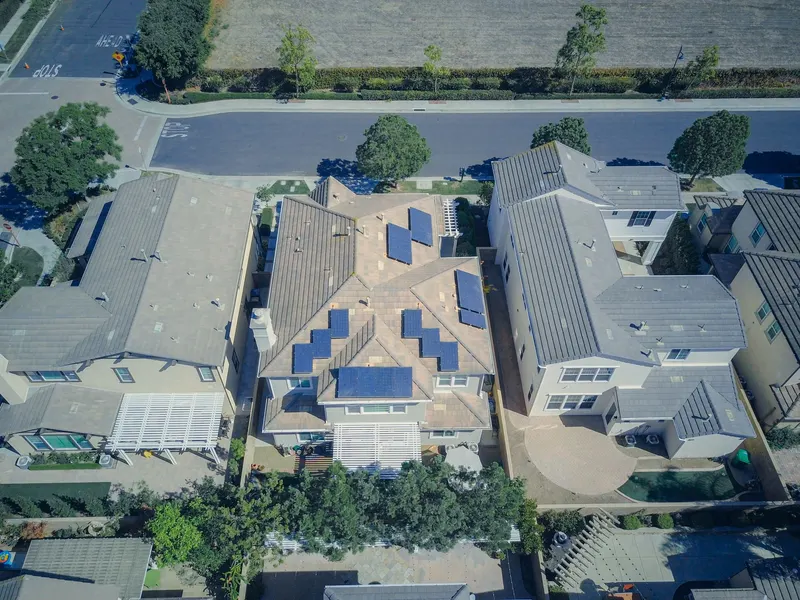
What are the main benefits of installing solar panels?
Installing solar panels offers several key benefits, primarily reducing electricity expenses and increasing home value.
One of the main reasons consumers choose to install rooftop solar panels is to lower their electricity bills S1. Homeowners who switch to solar can anticipate significant financial gains, with typical savings ranging from $37,000 to $154,000 across a 25-year period, not accounting for any additional incentives S3. This financial benefit is amplified by the fact that electricity rates in the U.S S3. are climbing at an average rate of 2.8% each year, making the economic argument for solar power even more compelling S3.
Beyond the direct savings on utility costs, solar panels also contribute to an increase in a home's overall market value S2. From an environmental standpoint, solar energy systems provide substantial advantages. They generate electricity without producing pollution or greenhouse gases and operate using a renewable resource, thereby avoiding the depletion of finite fossil fuels S4. This makes solar power a clean and sustainable alternative for energy consumption.
How long does it take for solar panels to pay for themselves?
For most homeowners who buy their rooftop solar system with cash, the time required for it to recoup its cost through savings on electricity bills is generally about 10.1 years S3S1. This period can be shortened by state tax credits or rebates S3.
To determine the solar payback period, several elements must be considered, such as how much electricity your household uses and generates S1. Your roof's suitability, including its dimensions, form, pitch, and any shading from trees, affects the potential solar energy output S1. Optimal generation is typically achieved with south-facing roofs that have a pitch from 15 to 40 degrees S1.
Your average monthly electricity consumption and the rates charged by your utility also influence savings S1. Homeowners with higher electricity rates, such as those paying over 15 cents per kilowatt-hour, often see greater savings and a faster payback period S3. For instance, states like California, Massachusetts, or New York, with their elevated electricity costs, frequently experience quicker returns on solar investments despite potentially higher labor rates S3.
Even without the federal tax credit, which considerably reduces the payback time, solar panels can be a sound investment for both financial and ecological advantages S2. Excluding incentives, the typical homeowner can achieve savings ranging from $37,000 to $154,000 over a 25-year period, indicating that the initial expense leads to long-term savings S3. Given that electricity prices rise by about 2.8% annually, the financial advantages of solar become increasingly attractive throughout the system's 25-30 year operational life S3.
What factors determine how much money I can save with solar?
The amount of money you can save with solar panels depends on several key factors, including your system's electricity production, current energy usage, and installation costs S3.
The amount of electricity your system can generate is essential, and this depends on your home's capacity for solar panels on the roof S1. If trees cast too much shade, the panels' effectiveness can be greatly diminished S1. The roof's dimensions, form, and angle are also important. South-facing roofs, angled between southeast and southwest, with a pitch from 15 to 40 degrees, usually provide the best results S1.
Your present electricity expenses and energy consumption directly influence how much you can save with solar power S1. The higher your electricity rates, the more significant your potential savings with solar will be S3. For example, if your rate exceeds 15 cents per kilowatt-hour (kWh), solar is more likely to yield considerable savings S3. You can find your typical monthly energy use on your utility bill and check current electricity prices via the Department of Energy's Energy Information Administration Utility Rate Database S1. The payment your utility provides for surplus energy returned to the grid also impacts your savings S1.
Lastly, the initial costs of installation and the availability of rebates and incentives greatly affect the total savings S3. Although the typical solar buyer saves between $37,000 and $154,000 over a 25-year period, this figure does not account for potential incentives S3. Most homeowners who purchase solar systems outright achieve a return on investment in approximately 10.1 years, a timeframe that could be reduced with state tax credits or rebates S3. Comparing offers and obtaining several estimates from various installers can help maximize your savings S3.
Are there situations where solar panels might not be worth it?
Rooftop solar panels may not be a sound investment for every homeowner S3. For instance, significant shade on your roof can diminish the effectiveness of solar panels, which function best with abundant sunlight S1. The dimensions, configuration, and pitch of your roof also play a role; south-facing roofs with a pitch from 15 to 40 degrees are generally considered optimal S1.
The economic advantages of installing solar panels are contingent upon your specific electricity consumption and the local cost of power S1. If your electricity costs are high, for example, 15 cents per kilowatt-hour (kWh) or more, solar energy will likely yield significant financial benefits S1. In states such as California, Massachusetts, or New York, where electricity prices are elevated, solar panels often recoup their cost more rapidly S3. Conversely, if your local electricity rates are quite low, the financial motivation for adopting solar may be lessened S3. The amount you save is also influenced by your utility's compensation for any surplus solar energy transmitted to the grid S1.
Although solar panels typically pay for themselves over time, their initial cost is substantial, and the duration for recouping this investment can differ S1S3. The average homeowner considering solar can expect a return on investment in approximately 10.1 years without any financial incentives S3. This payback timeline can be shortened through state tax credits or rebates and varies depending on the system's price, how it's financed, and the electricity costs saved S3. Services like EnergySage can assist homeowners in estimating potential expenses and savings S1. Even without the federal tax credit, solar panels can remain a valuable choice for both economic and environmental reasons S2.
What is the typical lifespan of a solar panel system?
Solar panel systems typically have a lifetime of 25 to 30 years, providing decades of electricity bill savings S3. This extended lifespan is a key factor in their financial viability for homeowners S3.
For most homeowners, solar panels prove to be a worthwhile investment S3. The average solar shopper can expect to save between $37,000 and $154,000 over a 25-year period, not including any potential incentives S3. These substantial long-term savings transform the initial cost into a beneficial investment S3.
The financial argument for solar panels is further strengthened by the consistent rise in electricity rates, which have climbed approximately 2.8% annually S3. This increase makes the savings from generating your own power even more significant over time S3. While solar panels are generally a sound investment, their suitability depends on several factors, including your homeownership status, current electricity prices, the cost of the solar system, and the suitability of your roof or property S3. For instance, if you pay a high electricity price, such as 15 cents per kilowatt-hour or more, solar is likely to deliver substantial savings S3. In states like California, Massachusetts, or New York, where electricity rates are high, solar often pays for itself more quickly, even with higher labor costs S3.
How do solar panels work?
A solar panel generates electricity from sunlight via numerous solar modules, each containing photovoltaic (PV) cells S4. These panels are also referred to as solar cell panels or solar electric panels S4.
PV cells are made from substances that, upon light exposure, energize electrons S4. The flow of these energized electrons through a circuit produces direct current (DC) electricity S4. This DC power can then be utilized for various appliances or kept in storage cells S4. The phenomenon of certain substances generating an electrical charge when exposed to light was first documented by French physicist Edmond Becquerel in 1839 S4.
A complete photovoltaic system typically includes several key components:
- Solar Panels: One or more panels that capture sunlight S4.
- Inverter: This device converts the direct current (DC) electricity produced by the panels into alternating current (AC) electricity, which is what most homes and the electricity grid use S4.
- Additional components might be integrated into the system, such as charge controllers, meters, or solar trackers, to maximize the absorption of direct sunlight S4.
Most solar panels are installed in large-scale solar farms or as rooftop solar panels on homes, supplying electricity to the grid S4. While they offer a clean and renewable energy source, reducing greenhouse gas emissions, their effectiveness depends on sunlight availability and intensity S4. For more information on how solar can impact your home, consider exploring articles like What factors determine how much money I can save with solar? and Are Solar Panels Worth It S4? A Comprehensive Guide for US Homeowners S4.